Post #1
 Online now
- Joined
- 16.04.2026
- Messages
- 54
- Reactions
- 28
- Location
- 🇹🇷
 TRTürkiye
FORD IDS YEAR : 300 $
FORD FJDS YEAR : 300 $
Ford FJDS (Ford J2534 Diagnostic System) is an official factory software application designed to provide dealer-level diagnostics, module reprogramming, and key programming for independent repair shops using standard SAE J2534 Pass-Thru hardware interfaces (such as Scanmatik 2 Pro, CarDAQ, etc.) instead of requiring expensive proprietary Ford VCM hardware.
(Note: It is commonly mentioned alongside or contrasted with Ford IDS and FDRS.)
What Does FJDS Do? (Key Features)#
- Module Reprogramming & Flashing: Downloads and installs official factory calibration updates to powertrain, body, and transmission control modules.
- Diagnostics & Software Testing: Reads and clears Diagnostic Trouble Codes (DTCs), views live data parameters, and performs bi-directional active tests.
- J2534 Compatibility: Unlike traditional IDS (which strictly requires Ford's proprietary hardware like the VCM II or VCM3), FJDS allows technicians to use standard, cost-effective J2534 pass-thru interfaces connected to a Windows PC.
- Security & Key Programming: Handles security access functions and key coding procedures depending on vehicle architecture.
How Does FJDS Fit Into the Ford Software Family?#
Ford splits its diagnostic software ecosystem based on vehicle model years and hardware requirements:- Ford IDS (Integrated Diagnostic System): The traditional, locally installed software built for legacy vehicles (roughly 1996 up to select 2018 models). It traditionally requires official Ford VCM hardware.
- Ford FJDS (Ford J2534 Diagnostic System): Created to give independent shops access to module flashing and diagnostics on select older-to-mid-range vehicles using standard J2534 pass-thru devices.
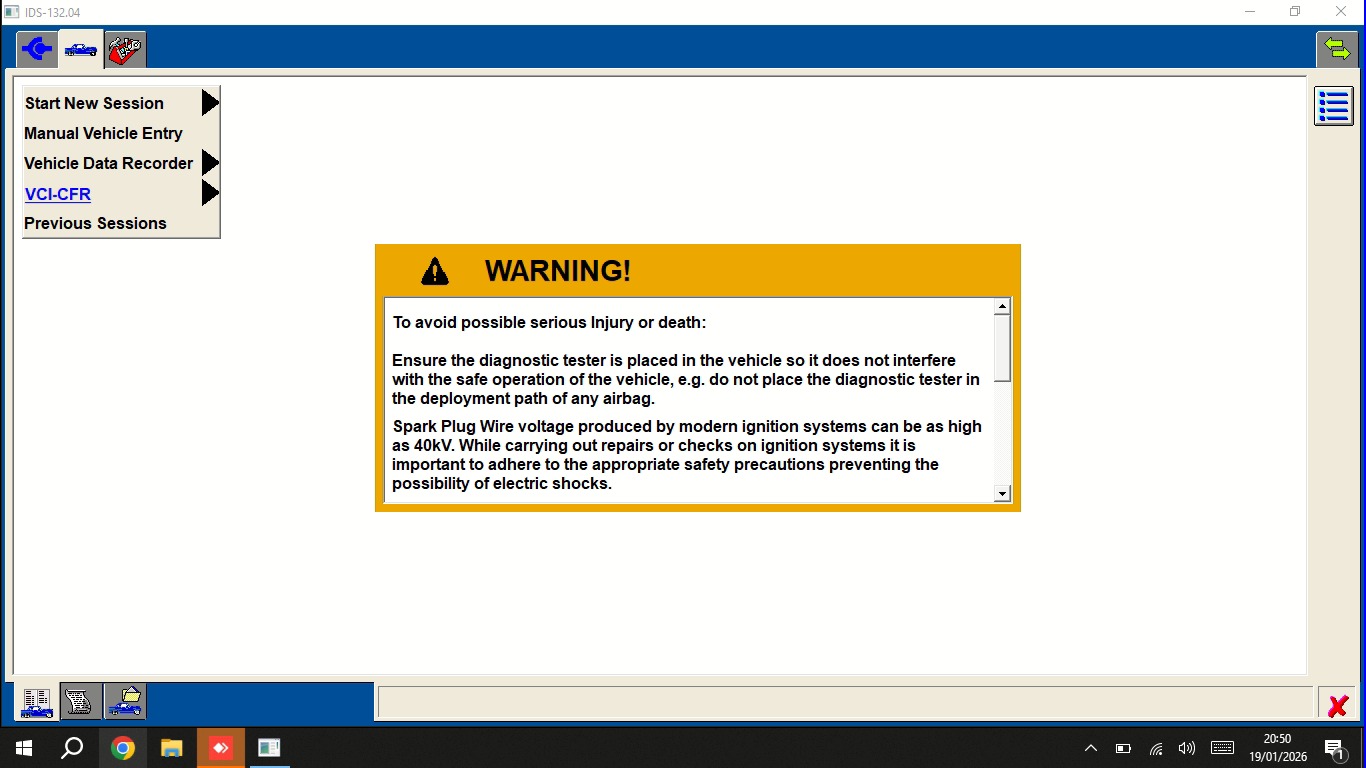
Ford IDS (Integrated Diagnostic Software) is the official, factory-level diagnostic and reprogramming software utilized by Ford and Lincoln dealerships worldwide. It is engineered to perform comprehensive dealer-level service functions on legacy and older-generation Ford, Lincoln, and Mercury vehicles (typically spanning model years 1996 up to select 2018 models before modern CAN-FD architectures took over).
What Does It Do? (Key Capabilities)- Full-System Module Programming & Flashing: Downloads and installs official factory calibration updates, fixes, and patches for electronic control units (PCMs, TCMs, ABS, Instrument Clusters, and Restraint/Airbag modules).
- Advanced Diagnostics & Datalogging: Reads, interprets, and clears manufacturer-specific Diagnostic Trouble Codes (DTCs), and streams real-time live sensor data with recording and playback capabilities.
- Specialized Service Functions: Executes deep factory service procedures such as PATS key programming, steering angle sensor (SAS) resets, diesel particulate filter (DPF/GPF) regenerations, automated brake bleeding, and injector coding.
- Bi-Directional Controls: Commands actuators and internal components directly to test system integrity and pinpoint electrical or mechanical faults.
Hardware & System Requirements#
Unlike newer cloud-based software variants, Ford IDS requires a specific setup to communicate with vehicles properly:
- Vehicle Communication Module (VCM): Traditionally requires official Ford hardware interfaces such as the VCM II, VCM3, or VCMM connected via USB or wireless. (Standard SAE J2534 pass-thru devices are generally unsupported on classic IDS, which is handled instead by its sibling application, FJDS).
- Dedicated Windows PC Environment: Runs locally on a Windows-based PC (ideally Windows 10 Professional, 64-bit) with sufficient RAM and storage to handle local calibration databases.
- Official Subscription / License: Fully functional operation requires an active license subscription through Ford's official technical service portal to unlock vehicle communication and download latest calibration files.
-
Context Note: For modern Ford vehicles (2018+ models featuring high-speed Ethernet and CAN-FD networks), Ford transitioned its primary operations to FDRS (Ford Diagnostic and Repair System), while IDS remains maintained as a legacy application for older vehicle architectures.