
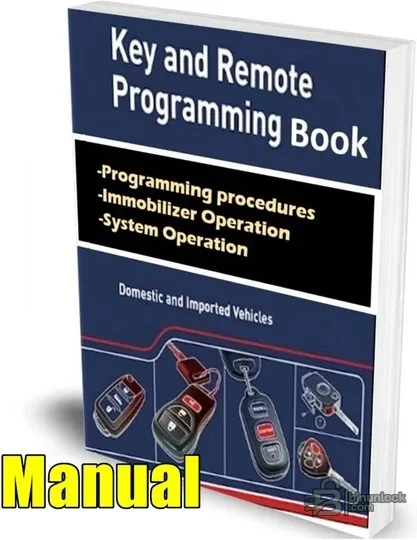
Automotive Key and Remote Programming Manual is a large PDF reference for locksmith and workshop procedures across domestic and imported vehicles from the conventional key-fob and early transponder era. It is intended to help identify whether a vehicle supports an onboard sequence, requires a diagnostic tool or needs a different immobilizer workflow.
A printed procedure is only a starting point. Key-learning rules vary by market, production date, immobilizer generation and the number of already enrolled keys. Confirm ownership, battery condition, exact vehicle application and tool capability before beginning; an incorrect sequence can erase working keys or trigger a security lockout.
Select procedures by make, model, model year, market and immobilizer generation rather than badge alone. A vehicle may use a separate remote and transponder, an integrated head key, a proximity system or a body-control-module learning routine. Facelift and regional changes can alter the sequence even when the body style looks identical.
Many remote-locking procedures can be performed through an ignition and door sequence, while transponder enrollment often requires security access and a compatible diagnostic tool. A remote that locks the doors is not proof that the immobilizer chip will start the engine. Treat the two functions separately and test both.
Use these procedures only for owned vehicles or documented customer-authorized work. Do not publish PINs, transponder data, key cuts, security seeds, customer addresses or full VINs. Comply with local locksmith licensing, recordkeeping and identity-verification requirements.
A printed procedure is only a starting point. Key-learning rules vary by market, production date, immobilizer generation and the number of already enrolled keys. Confirm ownership, battery condition, exact vehicle application and tool capability before beginning; an incorrect sequence can erase working keys or trigger a security lockout.
What the manual is designed to cover#
- Onboard remote-control programming sequences where supported
- Key and transponder learning prerequisites
- Domestic and imported vehicle procedure indexing
- Ignition-cycle, door-lock and button-sequence references
- Notes on when a diagnostic or locksmith tool is required
- Preparation steps before adding or replacing a key
Vehicle and system identification#
Select procedures by make, model, model year, market and immobilizer generation rather than badge alone. A vehicle may use a separate remote and transponder, an integrated head key, a proximity system or a body-control-module learning routine. Facelift and regional changes can alter the sequence even when the body style looks identical.
Required equipment#
- Legitimate proof of ownership and customer authorization
- All available working keys and remotes
- Fresh batteries for every remote and stable vehicle battery support
- Compatible diagnostic or locksmith programmer when onboard learning is not supported
- PIN or security access obtained through an authorized channel when required
- Current service information for emergency and all-keys-lost procedures
Safe programming workflow#
- Verify vehicle identity, market and immobilizer type before choosing a procedure.
- Count and test all existing keys and remotes; record which functions currently work.
- Read the entire procedure, including maximum-key count and erasure warnings.
- Stabilize vehicle voltage and fit fresh remote batteries.
- Perform the sequence once without improvising timing or extra ignition cycles.
- Test every key for mechanical operation, remote locking and engine authorization.
- Document the completed work and return all customer property securely.
Onboard programming versus diagnostic learning#
Many remote-locking procedures can be performed through an ignition and door sequence, while transponder enrollment often requires security access and a compatible diagnostic tool. A remote that locks the doors is not proof that the immobilizer chip will start the engine. Treat the two functions separately and test both.
Important compatibility limits#
- The manual cannot account for every regional or mid-year immobilizer change
- Later proximity and secure-gateway systems may require online authorization
- All-keys-lost procedures may differ from adding a spare key
- Used keys can be locked to another vehicle or use the wrong frequency
- A matching case shape does not prove correct transponder, frequency or part number
- Do not continue if the documented sequence conflicts with current OEM data
Troubleshooting failed learning#
- Remote enters programming mode but will not register: verify frequency, part number and battery
- Remote works but engine will not start: diagnose transponder enrollment separately
- No programming confirmation: recheck door/ignition prerequisites and timing
- Working keys stop responding: stop, preserve the remaining key state and use the correct recovery tool
- Security timer active: maintain stable voltage and follow the manufacturer wait procedure
- Diagnostic tool rejects access: confirm vehicle profile, PIN source and interface communication
Legal and security use#
Use these procedures only for owned vehicles or documented customer-authorized work. Do not publish PINs, transponder data, key cuts, security seeds, customer addresses or full VINs. Comply with local locksmith licensing, recordkeeping and identity-verification requirements.


