
Bosch ECU SW Number Finder is an offline binary-analysis utility that scans an ECU dump for candidate Bosch software-number strings. It also displays the loaded filename, exact file size and CRC32, giving a technician a quick identity snapshot before opening the file in a map editor or matching it against a calibration database.
The program is especially useful when a raw BIN arrives with an unhelpful filename or when several reads must be separated by software identity. It does not communicate with an ECU and it does not prove that every string it finds is the active calibration number.
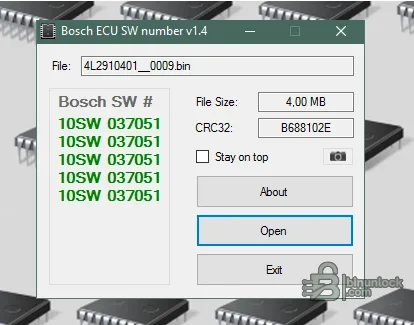
The genuine interface preview shows a four-megabyte example file, its CRC32 value and repeated software-number candidates extracted from the binary. Repetition is expected because identifiers can occur in multiple regions or copies.
CRC32 is convenient for grouping files but is not a cryptographic identity. Use SHA-256 for evidence and transfer verification.
Confirm the result against the ECU label, diagnostic identification and read-tool report. Do not rename a file as a different ECU family based on one embedded number.
Compressed archives, encrypted slave files, VBF/ODX containers and proprietary tuning-tool wrappers should be extracted or processed by the correct workflow first. Renaming them to BIN does not make them raw binaries.
If several different numbers are found, compare their offsets, nearby text and the ECU's live identification data before choosing one.
The application is portable and does not require a vehicle interface.
The program is especially useful when a raw BIN arrives with an unhelpful filename or when several reads must be separated by software identity. It does not communicate with an ECU and it does not prove that every string it finds is the active calibration number.
The genuine interface preview shows a four-megabyte example file, its CRC32 value and repeated software-number candidates extracted from the binary. Repetition is expected because identifiers can occur in multiple regions or copies.
What the finder reports#
- Selected binary filename
- File length in megabytes
- CRC32 for quick duplicate and integrity comparison
- Candidate Bosch software-number strings detected in the file
- A compact list that can be copied into job notes or used for further database research
CRC32 is convenient for grouping files but is not a cryptographic identity. Use SHA-256 for evidence and transfer verification.
Software number versus hardware number#
Bosch control units can expose several identifiers: ECU hardware number, software number, calibration identifier, assembly or OEM part number and internal dataset references. A string found inside a dump may represent one of these values, a compatibility reference or an older copy retained in the file.Confirm the result against the ECU label, diagnostic identification and read-tool report. Do not rename a file as a different ECU family based on one embedded number.
Suitable input files#
- Raw ECU flash reads from a documented OBD, bench or boot protocol
- Calibration-only reads where the software identifier region is present
- OEM or tuning files with their container already removed
- Known-good originals used to compare a customer file
Compressed archives, encrypted slave files, VBF/ODX containers and proprietary tuning-tool wrappers should be extracted or processed by the correct workflow first. Renaming them to BIN does not make them raw binaries.
Recommended identification workflow#
- Preserve the received file and calculate its SHA-256 hash.
- Record vehicle, engine, ECU label and reader protocol.
- Open a working copy in the finder.
- Save the displayed size, CRC32 and every candidate software number.
- Search for the same strings in a hex viewer and note their offsets.
- Compare diagnostic ECU identification and the programmer's read report.
- Match only against reference files from the same hardware and software family.
- Rename the working copy using a documented naming convention while retaining the original filename in the case record.
How to interpret repeated results#
Repeated software-number strings can be legitimate. An ECU file may contain a visible identification block, duplicated calibration headers, boot references or copies used for diagnostics. Repetition is stronger evidence than a random isolated string, but it is still not proof of active software without contextual validation.If several different numbers are found, compare their offsets, nearby text and the ECU's live identification data before choosing one.
Relationship to a Bosch ECU database#
This finder scans the actual bytes of one supplied dump. A database tool instead cross-references known ECU families and part numbers. The two workflows complement each other: first extract candidate identifiers from the file, then compare them with trusted reference records. Neither should be used to force a mismatched calibration onto an ECU.System requirements#
- Windows PC with 32-bit desktop application support
- Windows 7, 8.1, 10 or 11; use a clean VM for unsigned legacy tools
- .NET Framework desktop runtime
- At least 1 GB RAM and free storage for source and reference files
- Read access to the binary and write access only to a separate job-notes folder
- Optional hex editor and SHA-256 utility for independent validation
The application is portable and does not require a vehicle interface.
Limitations#
- Not every Bosch file stores a readable software number in plain text
- Partial reads may omit the identification region
- Encrypted, compressed or wrapped files can produce no meaningful result
- A detected identifier does not prove checksum validity or flash compatibility
- CRC32 collisions are possible and CRC32 is not suitable as the only integrity record
- The program does not identify maps, correct checksums or write ECUs
Package contents and integrity#
The original source contains an earlier build and the current build. The cleaned publication package keeps only the current executable so a technician cannot accidentally launch the older copy. Both source executables were hashed and inspected, while the published file is pinned by exact size, SHA-256 and PE version metadata. It is unsigned and was not executed during packaging.Troubleshooting#
- No software number appears: confirm the file is raw, complete and from a supported Bosch layout.
- Many unrelated numbers appear: examine their offsets and compare with the ECU label and diagnostic ID.
- CRC32 changed unexpectedly: re-hash the source and check whether a transfer, editor or antivirus altered it.
- File size is wrong: return to the read tool; do not pad or cut the file merely to match a reference.
- Windows blocks the executable: verify the pinned SHA-256 and test only in an isolated environment.


