
Bosch ME7.4.5 IMMO OFF is an offline EEPROM-file utility for controlled repair of supported PSA petrol engine control units. The program accepts a previously read ECU EEPROM dump by drag and drop, applies its immobilizer-data correction and saves the resulting file for verification and an authorized bench-write procedure.
This tool does not read the ECU, identify the hardware or connect to the vehicle. Compatibility must be established from the Bosch and PSA part numbers, processor/memory layout and exact dump size before any file is processed. Immobilizer work should be limited to lawful ECU replacement, recovery or bench diagnosis on a vehicle the technician is authorized to repair.
Do not feed the program a full flash, calibration-only read, partial bench-tool export or a dump from a similarly named Bosch family. ME7.4.4, ME7.4.5, ME7.4.6 and ME7.4.9 are separate variants and cannot be treated as interchangeable.
A file that is exactly 4 KB can still belong to the wrong ECU or contain a bad read. Byte count is only the first validation gate.
The same model and engine can appear with ME7.4.4, a Marelli controller or another hardware revision. Check the label and PCB; do not select a procedure from model/year alone.
Representative Bosch numbers reported for this family include the
In-circuit reads can be influenced by surrounding components. If repeated reads differ, stop and use the programmer manufacturer's verified procedure rather than accepting the first file that opens.
If the tool overwrites rather than creates a clearly named output on a particular system, preserve backups outside the working folder before starting. Never rely on the application's undo capability.
Before deciding that immobilizer data is the cause, perform a complete scan and compare the engine ECU, BSI and key-status information. For a normal replacement job, manufacturer-authorized pairing or virginization may be the correct route. Keep the original ECU and EEPROM dump so the vehicle can be restored and the repair remains traceable.
Run old unsigned automotive utilities in a dedicated or disposable environment. Scan the archive with current security tools and do not disable protection globally to make an unfamiliar executable start.
Static inspection does not constitute a malware-clean guarantee, and the software cannot verify a customer file on its own. Use it only for documented, authorized repair. Preserve original data, maintain a complete audit trail and do not use immobilizer modification to conceal theft, bypass ownership checks or defeat security on a vehicle without permission.
This tool does not read the ECU, identify the hardware or connect to the vehicle. Compatibility must be established from the Bosch and PSA part numbers, processor/memory layout and exact dump size before any file is processed. Immobilizer work should be limited to lawful ECU replacement, recovery or bench diagnosis on a vehicle the technician is authorized to repair.
Verified program workflow#
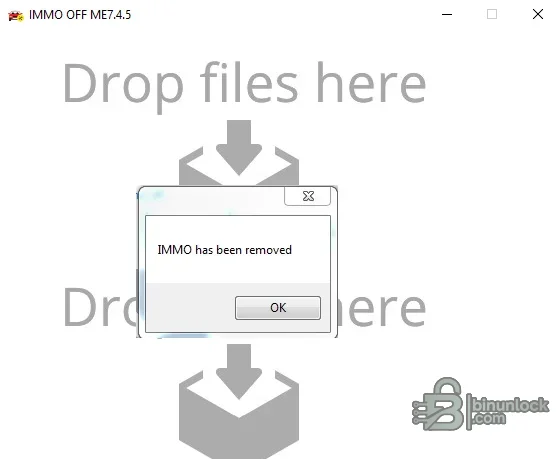
The application has a deliberately small drag-and-drop interface. A technician first reads the EEPROM with separate programming equipment, keeps an untouched backup and then drops a working copy onto the program. The supplied screenshot shows the successful completion dialog after the file operation.- Local drag-and-drop processing of a supported ME7.4.5 EEPROM file
- No OBD, CAN, K-Line or programmer driver is built into the application
- No vehicle or ECU auto-detection; the operator must verify identity before use
- The source package description identifies the correction region as addresses
00–60 - A completion message confirms only that the program wrote its result, not that the file matches the target ECU
Do not feed the program a full flash, calibration-only read, partial bench-tool export or a dump from a similarly named Bosch family. ME7.4.4, ME7.4.5, ME7.4.6 and ME7.4.9 are separate variants and cannot be treated as interchangeable.
ECU family and EEPROM requirements#
Bosch ME7.4.5 is documented on naturally aspirated PSA petrol applications, particularly 1.6-litre 16-valve engines with electronic throttle. Technical references for the immobilizer workflow identify a serial 95320 EEPROM, whose complete memory image is normally 4,096 bytes.- Confirm that the physical ECU is labelled Bosch ME7.4.5
- Confirm the EEPROM marking and organization from the board rather than from a vehicle list alone
- Use a complete, correctly oriented 95320 read when that is the memory fitted to the verified unit
- Repeat the read at least twice and require byte-for-byte agreement
- Reject all-FF, all-00, truncated, padded, byte-swapped or programmer-container files
- Record the Bosch number, PSA number, VIN, engine code and original immobilizer state with the job
A file that is exactly 4 KB can still belong to the wrong ECU or contain a bad read. Byte count is only the first validation gate.
Representative Citroën applications#
Published diagnostic and service-tool application lists associate ME7.4.5 with several PSA petrol platforms. These are useful search targets, not a universal compatibility promise:- Citroën C2 1.6 16V, including documented 80 kW and higher-output applications
- Citroën C3 / C3 II 1.6i with N6A or NFU engine coding where ME7.4.5 is physically fitted
- Citroën C4 / C4 Picasso 1.6i with N6A or NFU engine coding
- Citroën Xsara Picasso 1.6 petrol on documented ME7.4.5 part-number applications
The same model and engine can appear with ME7.4.4, a Marelli controller or another hardware revision. Check the label and PCB; do not select a procedure from model/year alone.
Representative Peugeot applications#
- Peugeot 1007 1.6 16V
- Peugeot 206 1.6i 16V with documented N6A/NFU ME7.4.5 variants
- Peugeot 207 1.6i only where the physical ECU and part numbers confirm this family
- Peugeot 307 1.6i 16V
- Other PSA 1.6 petrol installations listed by professional diagnostic/tuning platforms, subject to exact ECU verification
Representative Bosch numbers reported for this family include the
0 261 208 xxx range, but the suffix matters. PSA hardware and software references also vary. Never replace or edit an ECU solely because its connector looks similar.Required workshop equipment#
- EEPROM programmer that explicitly supports the fitted 95320-family device and the correct voltage
- Appropriate SOIC clip, adapter or desoldering equipment for the board and read method
- Regulated bench supply with current limiting when the ECU is powered outside the vehicle
- ESD-safe work area, magnification and controlled soldering/rework tools
- Hex editor and hashing utility for size, fill-pattern and before/after comparison
- PSA-capable diagnostic platform for identification, BSI/ECU fault checks and authorized commissioning
- Stable battery support for vehicle-side diagnostic work after the module is refitted
In-circuit reads can be influenced by surrounding components. If repeated reads differ, stop and use the programmer manufacturer's verified procedure rather than accepting the first file that opens.
Recommended EEPROM workflow#
- Record the vehicle, engine code, VIN, Bosch/PSA ECU numbers, symptom and reason for repair.
- Photograph the board and identify the EEPROM marking, pin 1 orientation and programmer connection.
- Read the memory at least twice. Compare the files and calculate a SHA-256 hash of the accepted original.
- Store the original as read-only evidence and process only a separately named working copy.
- Confirm expected file length and inspect for implausible fill or repeated programmer errors.
- Drop the working copy onto the utility. Never assume that the success dialog validates ECU identity.
- Compare the output with the original and require changes to be limited to the expected immobilizer-data region.
- Write with stable voltage, then read the EEPROM back and compare it byte-for-byte with the intended output.
- Refit the ECU, scan all related modules and document the final start, fault and configuration state.
If the tool overwrites rather than creates a clearly named output on a particular system, preserve backups outside the working folder before starting. Never rely on the application's undo capability.
Immobilizer, BSI and key-system boundaries#
On PSA vehicles the engine ECU participates in a larger authorization system involving the BSI, transponder key and stored configuration. An EEPROM modification is not a general repair for a non-start condition and does not diagnose power supply, CAN communication, crank sensing, fuel pressure, starter authorization or mechanical faults.Before deciding that immobilizer data is the cause, perform a complete scan and compare the engine ECU, BSI and key-status information. For a normal replacement job, manufacturer-authorized pairing or virginization may be the correct route. Keep the original ECU and EEPROM dump so the vehicle can be restored and the repair remains traceable.
System requirements#
- Windows desktop capable of running an unsigned 32-bit application
- Windows 7, Windows 10 or Windows 11 workshop environment; legacy compatibility settings may be needed
- Approximately 10 MB of free local storage for the program and working files, plus separate backup storage
- Permission to use drag and drop and create files in the selected working directory
- No internet connection, vehicle interface or account is required by the file utility itself
- A separate programmer and diagnostic system are required for the complete repair workflow
Run old unsigned automotive utilities in a dedicated or disposable environment. Scan the archive with current security tools and do not disable protection globally to make an unfamiliar executable start.
Troubleshooting#
- File is ignored: confirm that it is a raw binary EEPROM read, not a ZIP/RAR, programmer project, full flash or text export
- Unexpected file size: recheck the memory device and programmer organization; do not pad or truncate a dump to force acceptance
- Output differs across a large area: stop, restore the original working copy and verify the input and tool identity
- ECU does not communicate after writing: restore the verified backup where safe, check EEPROM orientation/soldering, ECU power/grounds and bench connections
- Engine remains immobilized: scan the ECU and BSI, confirm key recognition and configuration, and use the authorized matching procedure for the exact vehicle
- Program is blocked or fails to open: use an isolated compatible Windows system and independently scan the file rather than weakening the main workshop computer
Package verification and responsible use#
The cleaned package contains one portable executable. The source RAR was fully tested and extracted; the application is an unsigned x86 Windows program and was inspected statically without execution. The original source screenshot is used unchanged because it shows the genuine drag-and-drop window and completion dialog without personal data.Static inspection does not constitute a malware-clean guarantee, and the software cannot verify a customer file on its own. Use it only for documented, authorized repair. Preserve original data, maintain a complete audit trail and do not use immobilizer modification to conceal theft, bypass ownership checks or defeat security on a vehicle without permission.


