
Immo PIN Code Calculator is a file-based immobilizer utility for technicians who need to recover a security PIN from a supported ECU or body-system memory dump. Its strongest coverage is PSA engine controllers and BSI modules, with additional profiles for selected VAG and Opel controllers. The application works offline on binary data and does not connect directly to a vehicle.
Support is determined by the selected controller family, EEPROM/flash layout and exact dump length rather than by vehicle model alone. A Peugeot or Citroën badge does not prove that a file matches one of these algorithms.
The interface also shows Fiat/Ducato immobilizer-box entries marked A venir (forthcoming). They are placeholders and must not be treated as working support in this build.
These checks help reject an obviously wrong read, but they do not prove module identity or data integrity. Two unrelated controllers can use the same memory size, and a corrupted dump can still have the expected number of bytes.
Make at least two complete reads, compare them byte for byte and keep the untouched original in a protected backup location. Record the VIN, ECU/BSI part number, hardware and software identifiers, memory marking, read mode and file size before calculating a security code.
The calculator only derives a code from the supplied data. It does not program a transponder, adapt an ECU, synchronize a BSI, change a VIN, disable an immobilizer or verify that the vehicle ownership information is legitimate.
The executable is unsigned and portable. No installer, vehicle driver or communication interface is bundled. Use an isolated workshop system and scan the file with current security tools before opening it.
Supported PSA engine ECU families#
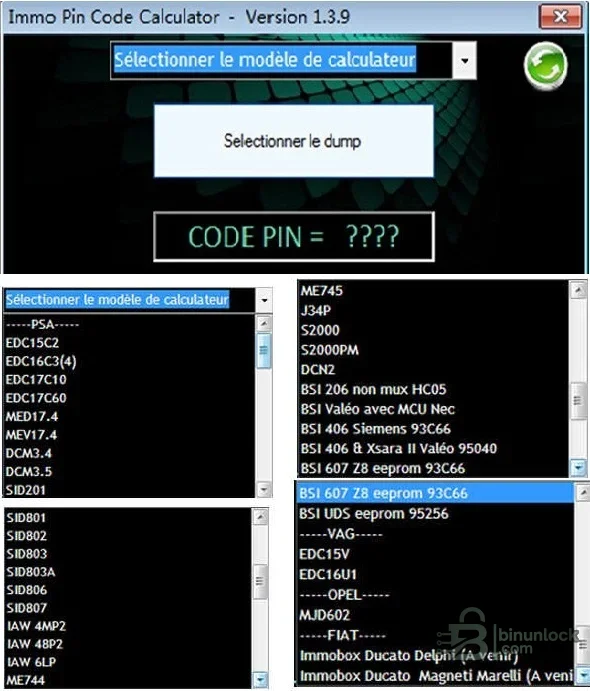
The calculator exposes the following PSA profiles in the application and its published support history:- Bosch diesel: EDC15C2, EDC15C7, EDC16C3/C4, EDC17C10 and EDC17C60
- Bosch gasoline: MED17.4, MEV17.4, ME7.4.4 and ME7.4.5
- Continental/Siemens: SID201, SID801, SID802, SID803, SID803A, SID806 and SID807
- Delphi: DCM3.4 and DCM3.5
- Magneti Marelli: IAW 4MP2, IAW 48P2 and IAW 6LP
- Other PSA profiles: J34P, S2000, S2000PM and Lucas DCN2
Support is determined by the selected controller family, EEPROM/flash layout and exact dump length rather than by vehicle model alone. A Peugeot or Citroën badge does not prove that a file matches one of these algorithms.
Supported PSA BSI, VAG and Opel profiles#
- BSI 206 non-multiplexed units using an HC05 microcontroller
- Valeo BSI with NEC microcontroller
- Siemens BSI 406 with 93C66 memory
- Valeo BSI 406/Xsara II with 95040 memory
- BSI 607 Z8 with 93C66 EEPROM
- BSI UDS with 95256 EEPROM
- VAG EDC15V and EDC16U1
- Opel MJD602
The interface also shows Fiat/Ducato immobilizer-box entries marked A venir (forthcoming). They are placeholders and must not be treated as working support in this build.
Dump-size validation built into the program#
The application checks the length of many inputs before calculating a PIN. Examples visible in its embedded validation messages include EDC16C3 dumps at 2,048, 4,096 or 8,192 bytes; EDC17C10 at 65,536 or 131,072 bytes; EDC17C60 at 196,608 or 262,144 bytes; SID807 at 32,768, 65,536 or 131,072 bytes; J34P at 2,048 bytes; and VAG EDC15V 24C04 at 512 bytes.These checks help reject an obviously wrong read, but they do not prove module identity or data integrity. Two unrelated controllers can use the same memory size, and a corrupted dump can still have the expected number of bytes.
Included reference files#
The clean package contains the calculator plus two small reference dumps: a Peugeot 208 EDC17C10 example and a Peugeot 307 EDC16C3/C34 example. They are useful for understanding the expected file shape and for checking that the calculator interface opens correctly. They are not universal donor files and must never be written to another vehicle.Required hardware and preparation#
This is an offline decoder, not an OBD diagnostic application. Obtain the ECU or BSI data with an EEPROM/flash programmer, boot/bench tool or other read method that explicitly supports the target controller. The correct pinout, voltage, adapter and read area depend on the exact module and are not included in this package.Make at least two complete reads, compare them byte for byte and keep the untouched original in a protected backup location. Record the VIN, ECU/BSI part number, hardware and software identifiers, memory marking, read mode and file size before calculating a security code.
Recommended PIN recovery workflow#
- Identify the exact ECU or BSI family from the module label and board hardware.
- Read the correct EEPROM or flash area with supported equipment and verify repeatable data.
- Open a copy of the dump and select the matching profile in the calculator.
- Confirm that the program accepts the file size and returns a plausible PIN.
- Cross-check the result with a second trusted method or authorized diagnostic system before key programming.
- Document the repair and retain the original dump, calculated result and vehicle identification together.
The calculator only derives a code from the supplied data. It does not program a transponder, adapt an ECU, synchronize a BSI, change a VIN, disable an immobilizer or verify that the vehicle ownership information is legitimate.
System requirements#
- Windows desktop; published compatibility covers Windows XP, 7, 8 and 10
- Microsoft .NET Framework 4 runtime; the supplied executable targets the CLR v4 family
- 32-bit application compatibility on a 32-bit or 64-bit Windows installation
- Read/write access to a local working folder for dumps and backups
- A separate programmer or diagnostic tool suitable for the target ECU/BSI
The executable is unsigned and portable. No installer, vehicle driver or communication interface is bundled. Use an isolated workshop system and scan the file with current security tools before opening it.


