
MAF-Calc is an offline diagnostic calculator that estimates the air mass a four-stroke engine should ingest from displacement, engine speed, absolute intake-manifold pressure, intake-air temperature and cylinder count. It presents the result as total mass flow and per-stroke air mass, giving a technician a theoretical reference that can be compared with live MAF data from a scan tool.
The calculator does not communicate with the vehicle and it does not test the sensor electrically. Its result is a model-based estimate, so it is most useful as one part of a structured airflow diagnosis alongside measured MAF, MAP, IAT, RPM, fuel-trim and engine-condition data.
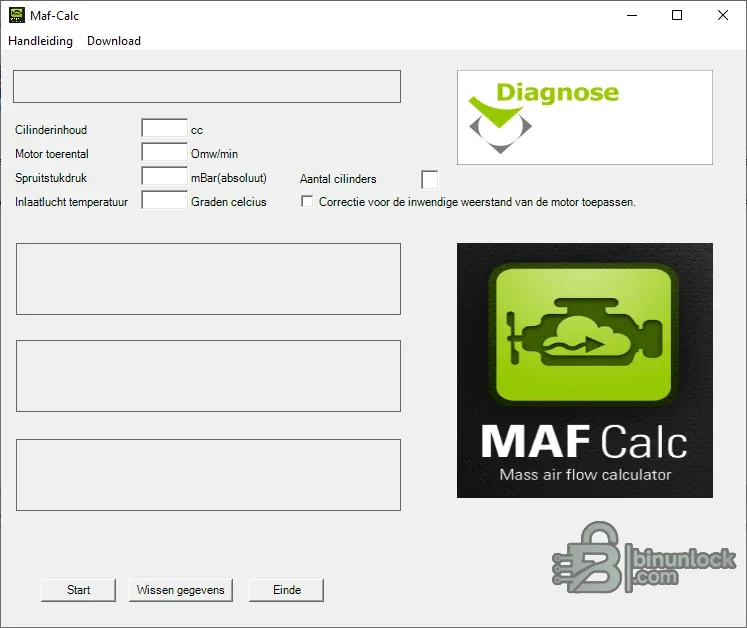
The screenshot shows the original Dutch labels, while embedded resources also contain English and German interface text. Decimal separators and regional number formatting can follow the active Windows locale, so use plain numeric input and check that the displayed values are interpreted correctly.
The calculation follows the same speed-density principles used by many diagnostic estimators: a four-stroke engine draws its displacement once every two crankshaft revolutions, while absolute pressure and absolute temperature determine air density. Real cylinder filling is affected by volumetric efficiency, valve timing, throttle position, turbocharger response, EGR flow, intake restriction and exhaust backpressure, so a calculated value is not a universal specification.
Do not perform a loaded road test while looking at a laptop. Use recorded data, a second technician or a safe chassis-dynamometer procedure appropriate to the vehicle.
Diagnostic trouble codes such as range/performance faults do not prove that the MAF sensor itself is defective. Compare the signal with manufacturer specifications when available, inspect wiring and power/ground, smoke-test the intake where appropriate and verify related sensors before replacing parts.
On diesel engines with active EGR, the mass measured at the air filter can differ from the total gas charge entering the cylinders because recirculated exhaust displaces fresh air. Compare EGR command/position and the manufacturer's specified air-mass value before judging the sensor from the calculator alone.
The package contains one unsigned portable executable and no installer, driver or vehicle database. On current Windows releases, the legacy runtime may need to be enabled separately; the installation method depends on the exact Windows build. Test the program in an isolated workshop environment and scan it with current security tools before use.
An order-of-magnitude difference usually indicates a unit or pressure-reference error. Correct the inputs first; do not use a convenient conversion factor simply to make the calculated and measured values agree.
MAF-Calc is a diagnostic aid rather than a substitute for manufacturer test plans or calibrated measuring equipment. Record the vehicle, engine code, operating condition, units and raw live data whenever sharing a result so another technician can reproduce the comparison.
The calculator does not communicate with the vehicle and it does not test the sensor electrically. Its result is a model-based estimate, so it is most useful as one part of a structured airflow diagnosis alongside measured MAF, MAP, IAT, RPM, fuel-trim and engine-condition data.
Inputs available in the calculator#
- Engine displacement: total cylinder capacity entered in cubic centimetres
- Engine speed: measured revolutions per minute at the same operating point as the scan data
- Intake-manifold pressure: absolute pressure in mbar, not gauge boost and not calculated vacuum
- Intake-air temperature: air temperature in degrees Celsius at the manifold or the most representative available sensor
- Number of cylinders: used to derive the per-cylinder/per-stroke value
- Internal-resistance correction: an optional model correction exposed by the original interface
The screenshot shows the original Dutch labels, while embedded resources also contain English and German interface text. Decimal separators and regional number formatting can follow the active Windows locale, so use plain numeric input and check that the displayed values are interpreted correctly.
Outputs and diagnostic meaning#
The program calculates an intake-air quantity in grams per second and grams per stroke. Grams per second can be compared directly with the standard MAF live-data PID when the scan tool reports g/s. The per-stroke value is useful for engines and ECUs that display cylinder filling or air charge in mg/stroke; convert units carefully before comparing.The calculation follows the same speed-density principles used by many diagnostic estimators: a four-stroke engine draws its displacement once every two crankshaft revolutions, while absolute pressure and absolute temperature determine air density. Real cylinder filling is affected by volumetric efficiency, valve timing, throttle position, turbocharger response, EGR flow, intake restriction and exhaust backpressure, so a calculated value is not a universal specification.
How to collect matching live data#
- Warm the engine fully and confirm that battery voltage and basic mechanical condition are normal.
- Use one stable operating point and capture RPM, MAF, MAP and IAT at the same timestamp.
- Enter the exact engine displacement and cylinder count from the vehicle specification.
- Convert MAP to absolute mbar if the scan tool uses kPa; do not enter manifold vacuum or boost pressure alone.
- Run the calculation with and without the optional correction and record both results.
- Compare the theoretical flow with the measured MAF together with fuel trims, boost target/actual and EGR command.
- Repeat at idle and one or more controlled loaded points instead of diagnosing from a single snapshot.
Do not perform a loaded road test while looking at a laptop. Use recorded data, a second technician or a safe chassis-dynamometer procedure appropriate to the vehicle.
Interpreting a mismatch#
A measured value below the estimate can be associated with a contaminated or biased MAF element, intake restriction, air leak after the sensor, incorrect MAP/IAT data, excessive EGR flow, restricted exhaust, low compression or variable-valve/turbo control problems. A high value can result from unmetered assumptions, a biased sensor, incorrect engine data, pressure-unit mistakes, boost leaks in a different location or an unsuitable volumetric-efficiency assumption.Diagnostic trouble codes such as range/performance faults do not prove that the MAF sensor itself is defective. Compare the signal with manufacturer specifications when available, inspect wiring and power/ground, smoke-test the intake where appropriate and verify related sensors before replacing parts.
Naturally aspirated, turbocharged and EGR engines#
For a naturally aspirated engine, manifold absolute pressure usually falls below barometric pressure at part load. On a turbocharged engine it can exceed atmospheric pressure under boost, and charge-air temperature becomes especially important. Always use absolute pressure: for example, a gauge boost value cannot be entered directly without adding the current barometric pressure.On diesel engines with active EGR, the mass measured at the air filter can differ from the total gas charge entering the cylinders because recirculated exhaust displaces fresh air. Compare EGR command/position and the manufacturer's specified air-mass value before judging the sensor from the calculator alone.
System requirements#
- Windows desktop capable of running a legacy 32-bit Windows Forms application
- Microsoft .NET Framework 2.0 runtime components, normally provided on modern Windows through the .NET Framework 3.5 feature or installer
- A local folder with permission to run the portable executable
- A scan tool or data logger able to capture RPM, MAF, MAP and IAT in known units
The package contains one unsigned portable executable and no installer, driver or vehicle database. On current Windows releases, the legacy runtime may need to be enabled separately; the installation method depends on the exact Windows build. Test the program in an isolated workshop environment and scan it with current security tools before use.
Units and common input errors#
- 1 kPa equals 10 mbar; 100 kPa absolute is approximately 1000 mbar absolute
- Convert engine displacement from litres to cubic centimetres before entry
- Use intake-air temperature, not coolant or ambient temperature, unless the diagnostic method explicitly calls for it
- Capture all inputs at the same operating point rather than mixing idle and loaded readings
- Check whether the scan tool reports g/s, kg/h, mg/stroke or another unit before comparison
An order-of-magnitude difference usually indicates a unit or pressure-reference error. Correct the inputs first; do not use a convenient conversion factor simply to make the calculated and measured values agree.
Package and safety notes#
The executable includes menu items for legacy online help and download pages. Those endpoints may no longer be available and are not required for the offline calculation. The program was inspected statically and was not executed during packaging; no malware-clean claim is made.MAF-Calc is a diagnostic aid rather than a substitute for manufacturer test plans or calibrated measuring equipment. Record the vehicle, engine code, operating condition, units and raw live data whenever sharing a result so another technician can reproduce the comparison.


