
PPD Maps is an open-source analysis and definition utility for full binary reads from selected Siemens diesel engine-control units. It scans a complete ECU image, identifies candidate calibration maps and their axes, locates diagnostic trouble-code tables and associated switches, and presents the detected structures in table and 3D views for technical review.
The program is best treated as a map-discovery and definition generator, not as an automatic tuning solution. It can export detected structures to XDF for TunerPro or A2L/ASAP2 for import into WinOLS, but the operator remains responsible for validating every address, axis, scaling rule and calibration change against the exact ECU software. It does not replace a verified DAMOS/A2L project, engineering documentation or checksum-aware flashing workflow.
A complete BDM read is mandatory. The author explicitly warns that a partial OBD read from tools such as MPPS does not contain the full address space required by the detection algorithms and will not work correctly.
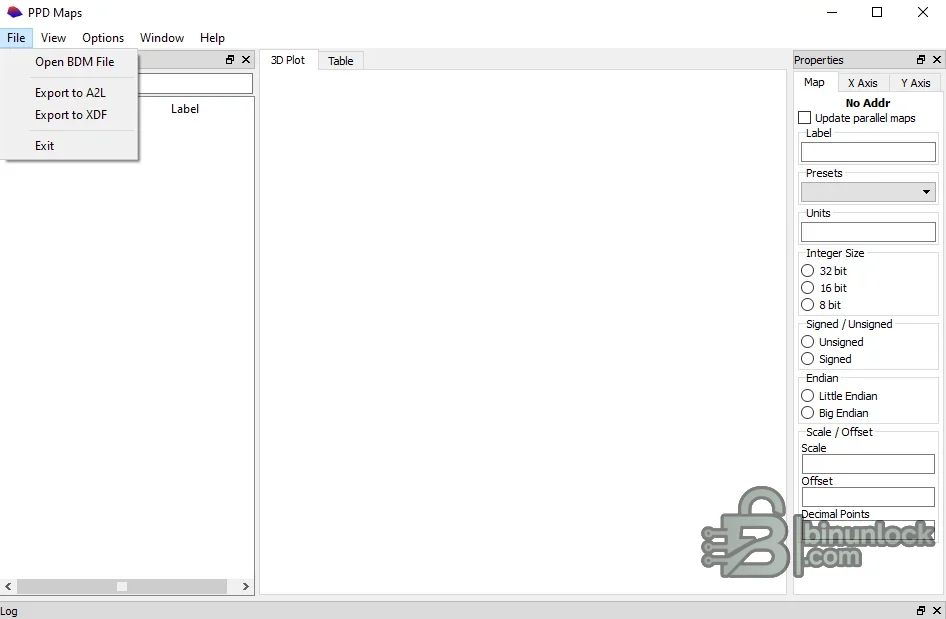
The central view can show a selected map as a colored table or a 3D surface. These visualizations help reveal axis orientation, gradients, limiters and obviously incorrect scaling, but visual shape alone does not prove a map's purpose.
Do not load a different Continental/Siemens family merely because its name begins with SID. SID202, SID208, SID807, PCR, SIMOS and other controllers use different structures unless specifically supported by this application.
That vehicle list is only a family-level orientation. Volkswagen Group used Bosch EDC16, Siemens PPD and later common-rail controllers across visually similar cars and engines. Confirm the ECU label, part number, software identification and processor/read method; never select PPD solely from the model badge or engine displacement.
A vehicle can use another ECU with the same engine marketing name. Match the Siemens/Continental number, Ford engineering number, code version and full-read size before trusting detected structures.
Coverage is binary-structure based rather than a model database. Examples in the test set demonstrate that the same detector can report very different numbers of maps, DTCs and switches by code version. Always preserve the exact identification string and part number alongside the binary.
A suitable source file should be:
Virtual reads and reconstructed files may be useful for other tasks but should not be assumed equivalent to the full physical read expected by this tool.
The Update parallel maps option can propagate definition-property changes to related detected structures. Verify the relationship first; similar dimensions do not necessarily mean the maps serve the same operating mode.
If a surface looks chaotic, do not immediately conclude that the calibration is corrupt. Check whether the detector selected the wrong start address, whether the values are signed, whether the axes are swapped and whether the file is a genuine full read.
A detected switch should not be altered simply to hide a warning. Suppressing fault reporting can leave the ECU in fail-safe behavior, conceal a genuine mechanical/electrical defect, violate emissions law and make later diagnosis unsafe. Use this information for authorized research, repair validation or lawful off-road development, and retain an untouched original.
An XDF describes where data is and how to display it. It does not add checksum correction, safe calibration limits or flashing support.
After import, compare the generated project with any trusted OLS/DAMOS source and the original ECU binary. A2L export does not make inferred names authoritative, and address interpretation can depend on how the reading tool lays out memory.
The Windows executable is a native Qt/OpenGL 32-bit application and is unsigned. It was inspected statically and not launched during packaging because a genuine source screenshot was supplied. Scan it independently and use it only with disposable copies of ECU files.
The rebuilt publication archive uses encrypted headers, is independently tested and extracted, and the resulting executable is matched to the pinned clean-payload SHA-256.
The program is best treated as a map-discovery and definition generator, not as an automatic tuning solution. It can export detected structures to XDF for TunerPro or A2L/ASAP2 for import into WinOLS, but the operator remains responsible for validating every address, axis, scaling rule and calibration change against the exact ECU software. It does not replace a verified DAMOS/A2L project, engineering documentation or checksum-aware flashing workflow.
A complete BDM read is mandatory. The author explicitly warns that a partial OBD read from tools such as MPPS does not contain the full address space required by the detection algorithms and will not work correctly.
What PPD Maps detects#
After a supported full binary is opened, the application analyzes code and data structures to build a navigable project containing:- Calibration maps: candidate data tables found by ECU-family-specific patterns
- X and Y axes: corresponding axis addresses and dimensions where the relationship can be determined
- Map metadata: labels, units, integer width, signedness, endianness, scale, offset and decimal display settings
- Diagnostic tables: DTC/P-code entries identified inside supported binaries
- Associated switches: one-byte locations linked by the analyzed program logic to specific DTC records
- File identification: manufacturer, ECU type, code version, part number and information string where recognized
- Problem log: maps without axes, adjacent-map conflicts, fallback detections and discarded duplicates
The central view can show a selected map as a colored table or a 3D surface. These visualizations help reveal axis orientation, gradients, limiters and obviously incorrect scaling, but visual shape alone does not prove a map's purpose.
Supported ECU families#
The author's published support level is:- Siemens PPD: primary and mature target, including PPD1.x binary structures used by Volkswagen Group diesel applications
- Siemens SID206: fully supported by the later detection algorithm
- Siemens SID803A: fully supported for map, DTC and switch analysis
- Siemens SID803: partial support; expect more unresolved or incorrectly related maps
- Siemens SID201: very limited or barely working support; use results only as research leads
- SID30X family: preliminary detection added late in development and not equivalent to fully validated support
Do not load a different Continental/Siemens family merely because its name begins with SID. SID202, SID208, SID807, PCR, SIMOS and other controllers use different structures unless specifically supported by this application.
Representative Volkswagen Group PPD applications#
The author's own test set identifies PPD1.1, PPD1.2, PPD1.3 and PPD1.5 files with Volkswagen/Audi part numbers such as the03G 906 018 family. These controllers are associated with selected Volkswagen Group 2.0 TDI pump-nozzle applications from the mid-to-late 2000s. Depending on engine code and market, related platforms can include Volkswagen Golf/Jetta, Passat, Touran and Eos; Audi A3; Škoda Octavia; and SEAT Leon, Altea or Toledo.That vehicle list is only a family-level orientation. Volkswagen Group used Bosch EDC16, Siemens PPD and later common-rail controllers across visually similar cars and engines. Confirm the ECU label, part number, software identification and processor/read method; never select PPD solely from the model badge or engine displacement.
Representative SID206 applications#
The validated project test files identify SID206 primarily as a Ford diesel controller. Current compatibility catalogs associate SID206/MPC563 with selected 1.4, 1.8 and 2.0 TDCi applications, including variants of:- Ford Fiesta and Mazda 2 in selected 1.4 TDCi applications
- Ford Focus and C-Max in selected 1.8/2.0 TDCi configurations
- Ford Mondeo, S-Max and Galaxy in selected 1.8/2.0 TDCi configurations
- Ford Kuga in selected 2.0 TDCi configurations
- Ford Tourneo Connect and Transit Connect in selected 1.8 TDCi applications
A vehicle can use another ECU with the same engine marketing name. Match the Siemens/Continental number, Ford engineering number, code version and full-read size before trusting detected structures.
Representative SID803 and SID803A applications#
The author's test results contain Ford and Peugeot SID803 files, plus Peugeot and Volvo SID803A files. These families appear in selected 2.0 and 2.7 HDi/TDCi/D diesel applications across Peugeot, Citroën, Ford, Volvo and related shared-powertrain platforms.Coverage is binary-structure based rather than a model database. Examples in the test set demonstrate that the same detector can report very different numbers of maps, DTCs and switches by code version. Always preserve the exact identification string and part number alongside the binary.
Why a full BDM read is required#
PPD Maps examines relationships between executable code, calibration data, axes, DTC tables and switch references across the complete flash address space. An OBD tuning read may contain only selected calibration regions, omit executable code, reorder blocks or add a tool-specific header. In that case, addresses cannot be resolved reliably.A suitable source file should be:
- A complete BDM/JTAG/bench read for the exact ECU and memory layout
- Read at least twice and compared byte-for-byte
- Stored without tool headers, compression or encryption
- Accompanied by ECU label, hardware, software, code-version and vehicle information
- Kept as a read-only original before any analysis or export
Virtual reads and reconstructed files may be useful for other tasks but should not be assumed equivalent to the full physical read expected by this tool.
Map and axis review workflow#
- Open an untouched copy of the full BDM binary.
- Verify the detected manufacturer, ECU type, code version, part number and information string.
- Review the problem log before accepting the generated map list.
- Filter maps by label or location and inspect the linked X/Y axes.
- Check data width, signedness, byte order, dimensions, scale, offset and engineering units.
- Compare shapes and addresses with a known original, trusted DAMOS/A2L or independent disassembly.
- Rename only structures whose function is technically supported.
- Export definitions, then perform any binary changes in a checksum-aware editor on a separate working copy.
The Update parallel maps option can propagate definition-property changes to related detected structures. Verify the relationship first; similar dimensions do not necessarily mean the maps serve the same operating mode.
Table and 3D visualization#
The Table view displays raw or scaled values in a colorized grid, helping expose plateaus, transitions and axis direction. The 3D view renders the same matrix as a surface. Both depend on correct dimensions, integer size, endianness and scaling.If a surface looks chaotic, do not immediately conclude that the calibration is corrupt. Check whether the detector selected the wrong start address, whether the values are signed, whether the axes are swapped and whether the file is a genuine full read.
DTC and switch analysis#
Supported files contain a DTC table mapping diagnostic entries to P-codes and controller behavior. PPD Maps can identify these entries and trace associated one-byte switches through ECU-family-specific assembly patterns. This is useful for understanding fault architecture and correlating a code with its software location.A detected switch should not be altered simply to hide a warning. Suppressing fault reporting can leave the ECU in fail-safe behavior, conceal a genuine mechanical/electrical defect, violate emissions law and make later diagnosis unsafe. Use this information for authorized research, repair validation or lawful off-road development, and retain an untouched original.
Export to TunerPro XDF#
The XDF export converts detected maps and axes into a definition file that can be opened by a current TunerPro build. After import:- Confirm that the XDF base addresses match the exact original binary
- Check map dimensions, axis links and byte order
- Validate scale and offset against engineering data
- Review every generated definition; detection quality varies by ECU family and code version
- Keep the XDF tied to the source binary's SHA-256 and software identifiers
An XDF describes where data is and how to display it. It does not add checksum correction, safe calibration limits or flashing support.
Export to A2L/ASAP2 and WinOLS#
The A2L export creates ASAP2-style measurement/calibration definitions that can be imported into compatible WinOLS workflows. DTC switches are placed in their own group in later program builds.After import, compare the generated project with any trusted OLS/DAMOS source and the original ECU binary. A2L export does not make inferred names authoritative, and address interpretation can depend on how the reading tool lays out memory.
System requirements#
- Windows PC with native 32-bit x86 application support; WOW64 is required on 64-bit Windows
- Windows 7-era compatibility is the safest baseline; Windows 10/11 may require compatibility settings or an isolated VM
- 1 GHz processor and at least 1 GB RAM; 2 GB or more is recommended for full binary analysis and 3D rendering
- At least 100 MB free for the utility and separate protected storage for originals, exports and edited copies
- 1024×768 or higher display resolution; a larger screen is preferable for docks, table and 3D plot
- OpenGL-compatible display driver for the 3D view
- A BDM/JTAG/bench-capable ECU tool that can produce a verified full read
- TunerPro for XDF use or WinOLS for A2L import, if export integration is required
- A checksum-capable editor or flashing tool appropriate to the exact ECU before any modified file is written
The Windows executable is a native Qt/OpenGL 32-bit application and is unsigned. It was inspected statically and not launched during packaging because a genuine source screenshot was supplied. Scan it independently and use it only with disposable copies of ECU files.
Package contents and integrity#
The cleaned package contains one standalone file, PPD-Maps.exe. The source RAR passed a full test and exact extraction; it contains no nested archive, pointer wrapper or unrelated installer. The embedded product identity names PPD Maps and Siemens PPD Map Detection.The rebuilt publication archive uses encrypted headers, is independently tested and extracted, and the resulting executable is matched to the pinned clean-payload SHA-256.
Limitations and safe-use rules#
- Full support is limited to PPD, SID206 and SID803A; SID803 is partial and SID201 is highly experimental
- Only a complete BDM-style binary is suitable for reliable analysis
- Detected maps and names must be independently validated
- The program does not perform ECU reading, checksum correction or flashing
- It does not guarantee safe calibration limits or vehicle compatibility
- Do not write a generated or edited file without a verified original and recovery method
- Do not suppress DTCs that report unresolved emissions, safety or hardware faults
- Keep every definition tied to the exact binary hash and ECU identification
Troubleshooting#
- File is not recognized: confirm that it is a complete unmodified BDM read and belongs to a supported family.
- No maps are found: verify file size/layout and ECU support; partial OBD or virtual reads are the most common cause.
- Many maps lack axes: review the problem log, code version and support level; do not manufacture axis links from visual similarity.
- Values or graphs look wrong: check 8/16/32-bit width, signedness, big/little endian, scale and offset.
- Exported XDF does not line up: ensure TunerPro opened the exact same unmodified binary and that no read-tool header shifted addresses.
- A2L import is offset: compare address conventions between the BDM layout and the importing WinOLS project.
- 3D view is blank or unstable: update the display driver or use an isolated Windows 7-era VM with compatible OpenGL.
- Security software reports the executable: quarantine it, verify the SHA-256 identity and obtain an independent scan before deciding whether to run it.


