
Description
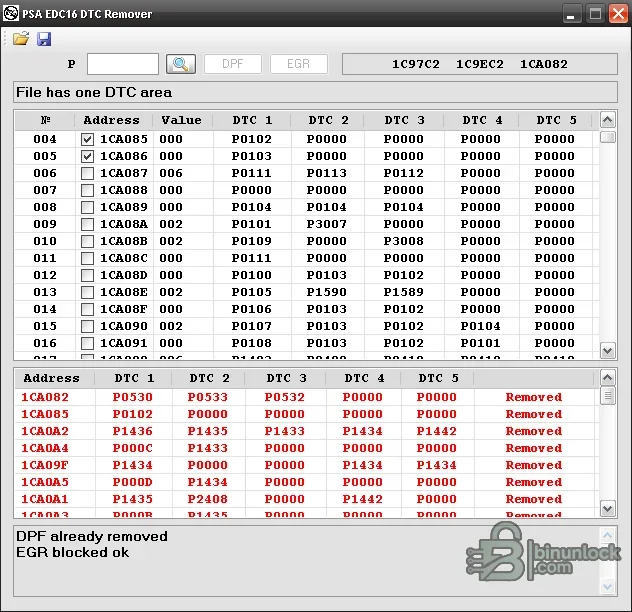
PSA EDC16 DTC Remover is an offline binary editor for supported Peugeot and Citroen Bosch EDC16 engine-control files. It locates recognized diagnostic-trouble-code table entries, shows their addresses and mapped codes, lets the operator select individual records and saves a separately named modified file.
Supported vehicles, ECUs and files#
The target family is PSA Bosch EDC16, but internal layouts differ across EDC16C0, EDC16C34, EDC16CP39 and software revisions commonly encountered in Peugeot/Citroen work. The packaged program does not include a definitive ECU list, so support must be established when the exact binary is recognized and the displayed DTC table is structurally plausible.- Peugeot and Citroen EDC16 binaries whose DTC table layout is implemented by the application.
- Individual DTC entries displayed with address, stored value and interpreted fault code.
- DPF and EGR status information where those flags are recognized by the file parser.
- Offline file editing only; no ECU read/write communication is included.
Functions#
- Open a full ECU binary and scan for the supported table structure.
- Review multiple DTC slots and select only the intended records.
- Mark selected entries for removal and save an output with a distinct filename suffix.
- Display the application’s DPF/EGR status without claiming a full diagnostic scan.
System and hardware requirements#
- A Windows PC with a compatible .NET Framework environment.
- A complete BDM/bench/boot/OBD read appropriate to the exact EDC16 and programming tool.
- Verified ECU hardware/software identification and a diagnostic report tying the code to a repaired or intentionally altered function.
- External checksum correction/verification and stable programming power where required.
Recommended workflow#
- Diagnose and repair the underlying fault first; save DTC and freeze-frame evidence.
- Hash the untouched full read and open only a copy.
- Confirm each displayed code/address is credible, remove the minimum intended entry and compare every changed byte.
- Correct checksums if needed, program with recovery available and verify that unrelated diagnostics still operate.


