
Description
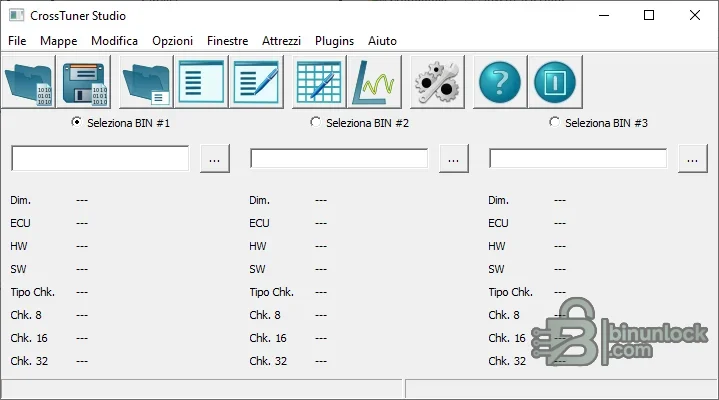
CrossTuner Studio is a portable ECU calibration-map editor for inspecting binary files, applying map definitions and comparing calibration data without installing a full tuning suite. The application can load several BIN files in one workspace and combines table editing, engineering-value conversion and graphical map inspection.
Supported vehicles, ECUs and files#
CrossTuner does not identify every ECU automatically. Its useful coverage is determined by a matching definition that describes the map address, data type, dimensions and conversion formula for the binary being opened. The interface provides ECU, hardware, software and checksum information panels, but a displayed field is not proof that an edited file is ready to flash.- Raw ECU BIN files for which a correct CrossTuner map definition is available.
- Up to three calibration files visible in the interface for reference or comparison work.
- User-created and shareable definitions for supported table and parameter layouts.
- Legacy Windows and Linux environments documented by the original developer.
Functions#
- Display defined maps as tables with converted engineering values rather than only raw hexadecimal data.
- Inspect calibration surfaces with the bundled plotting components and 3D visualization.
- Edit map values and maintain reusable definition metadata for known ECU software.
- Review 8-bit, 16-bit and 32-bit checksum information exposed by the application.
System and hardware requirements#
- A compatible desktop environment; the original developer lists Windows XP, Vista and 7 plus Linux.
- No installer is required, but the complete portable wxWidgets and gnuplot directory tree must remain together.
- A verified original ECU binary and a definition that matches its exact hardware/software revision.
- A separate checksum solution and programming tool where the application does not explicitly complete those stages.
Recommended workflow#
- Hash and archive the original BIN, identify the ECU software and choose only a matching definition.
- Open a copy, verify several known axes or maps against trusted documentation, and reject a definition whose addresses look implausible.
- Make small, documented changes and compare every modified region with the source.
- Validate checksums and file size externally before any programming operation.


