
PSA TPROT Remover is a dedicated offline utility with separate processing tabs for Bosch MD1CS003 and EDC17C60 engine-controller files used in supported Peugeot and Citroën workflows. Each tab presents a deliberate Open File, TPROT OFF and Save File sequence, reducing the risk of applying a generic раtсh intended for a different ECU family.
The two family names are the proven scope of the supplied interface. Vehicle models, engine codes, software revisions and read formats still vary, so the ECU label and original binary must be verified before processing.
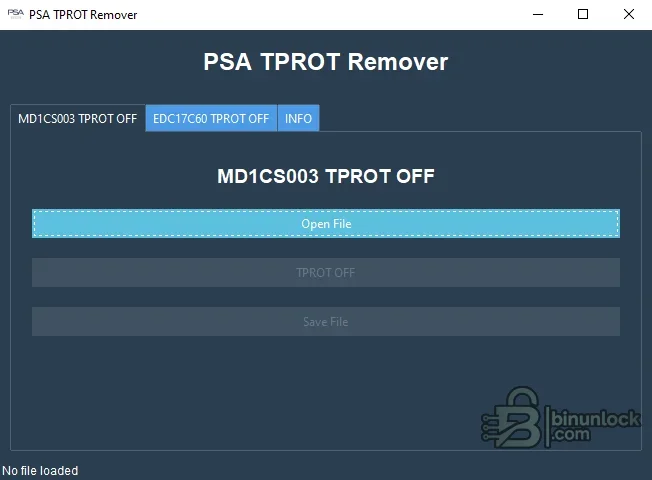
The two family names are the proven scope of the supplied interface. Vehicle models, engine codes, software revisions and read formats still vary, so the ECU label and original binary must be verified before processing.
What this resource is for#
Use this resource when a qualified calibrator or ECU technician has a supported PSA binary and a documented need to process its tuning-protection data. It works on local files only and must be paired with the correct read/write method, stable power and a recoverable original.Confirmed functions#
- Choose the MD1CS003-specific processing page
- Choose the EDC17C60-specific processing page
- Open an existing ECU binary
- Apply the controller-family TPROT operation
- Save the result as a separate working file
- Keep family selection visible throughout the operation
Supported vehicles, controllers and files#
- Bosch MD1CS003 files used in selected PSA diesel applications
- Bosch EDC17C60 files used in selected Peugeot and Citroën applications
- Support is limited to binaries recognized by the packaged algorithms
- Controller family alone does not guarantee every hardware or software revision
- Virtual reads and full physical reads must not be interchanged without proof
Package contents#
- Single portable 64-bit Windows executable
- Original screenshot showing both supported ECU-family tabs
- No map packs, DAMOS, firmware collections, drivers or vehicle interface
- Executable has no embedded product-version metadata and was audited statically without launch
System, hardware and interface requirements#
- 64-bit Windows workstation or isolated virtual machine
- Exact MD1CS003 or EDC17C60 original read
- Programmer that supports the target ECU and chosen file type
- Hex/binary comparison tool and checksum validation appropriate to the controller
- Regulated bench or vehicle support supply for any subsequent write
Recommended workshop workflow#
- Record the vehicle, controller label, hardware number, software number and communication method before starting.
- Read the original twice where practical, compare hashes and store one untouched copy outside the working directory.
- Confirm that file type, segment, byte length and ECU family match the selected function.
- Perform one documented operation on a copy and review every changed region before saving.
- Reopen or recheck the output, then validate it with the programmer or diagnostic platform before writing.
- Use regulated power during vehicle or bench work and complete a full identification and fault scan afterward.
Compatibility limits and responsible use#
- A file that opens successfully is not automatically compatible with the target controller, vehicle or hardware revision.
- Preserve a verified original read and compare byte length, identifiers and modified ranges before any write.
- Security, identity, emissions and anti-theft functions must be used only on property the technician is authorized to service and where the change is lawful.
- The supplied application does not replace OEM service information, stable power, a compatible interface or a tested recovery route.
- An unsigned legacy executable should be isolated and independently scanned before use; no malware-free claim is made.
- Emissions-related changes may be illegal for road use and are not validated by this utility
Troubleshooting#
- File is rejected: verify full-read versus calibration-read format, exact byte length, family and software revision.
- Output is unchanged: confirm that the expected signature or supported data structure is actually present.
- Unexpectedly large changes: stop and compare against the original; do not flash an unexplained result.
- Vehicle communication fails: check power, grounds, ignition state, interface driver and bus wiring separately from file processing.
- Module does not recover after writing: restore the exact original with the documented bench or boot recovery method.


