
UnlockECU is a visual and console seed-key calculation toolkit backed by a definition database. The interface lists module or project names, security levels, seed and key sizes, algorithm providers and parameters, then accepts a hexadecimal seed and returns the corresponding response when the selected definition is supported. Visible definitions include numerous Daimler/Mercedes project labels and several provider families.
The program calculates data only; it does not connect to a vehicle, request a seed or submit a response. A seed is session- and operation-specific, and security access never proves that a subsequent coding or programming action is compatible.
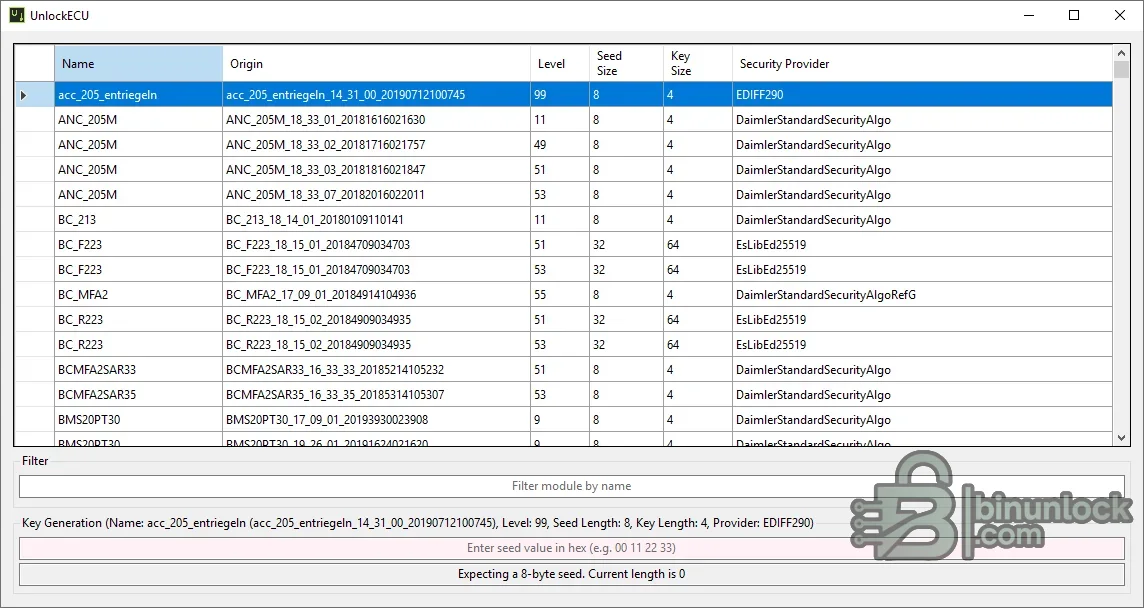
The program calculates data only; it does not connect to a vehicle, request a seed or submit a response. A seed is session- and operation-specific, and security access never proves that a subsequent coding or programming action is compatible.
What this resource is for#
Use the resource as an offline companion during an authorized diagnostic or engineering session that explicitly requests a supported seed-key response. It is useful for definition research, bench recovery and controlled module service where the exact project, access level and algorithm are known.Confirmed functions#
- Browse and filter the included module-definition database
- Review security level, seed size, key size and parameter fields
- Choose the algorithm provider associated with a definition
- Enter a hexadecimal seed from the active diagnostic session
- Calculate a key for the selected supported definition
- Use either the graphical or console front end
- Keep definitions in a readable JSON database for technical review
Supported vehicles, controllers and files#
- The supplied database visibly includes Daimler/Mercedes project labels such as ACC, ANC and body-controller families
- Providers visible in the interface include EDIF F290, Daimler-standard, EsLib Ed25519 and related algorithms
- Definition rows specify seed and key lengths rather than assuming one universal format
- Coverage is definition-specific and not a blanket claim for every ECU or TCM
- Newer online-authenticated diagnostic systems may not accept offline legacy algorithms
Package contents#
- Visual Windows front end
- Console Windows front end
- Core UnlockECU calculation library
- Readable definition database
- Bouncy Castle cryptographic runtime and .NET configuration files
- Nine clean package files, all hash-pinned and statically inspected
System, hardware and interface requirements#
- 64-bit Windows workstation with the required .NET runtime
- Authorized diagnostic application or bench tool that supplies the live seed
- Exact ECU/project name, security level and requested operation
- Reliable hexadecimal capture without spaces, truncation or stale-session reuse
- Lawful service authority and a documented recovery path for the target module
Recommended workshop workflow#
- Record VIN, module part number, project and requested diagnostic operation
- Capture the seed and security level from the active session
- Filter definitions and verify provider plus seed/key lengths
- Enter the seed once and calculate the response
- Return the response only to the same session before timeout
- Continue with the authorized operation and save a redacted technical log
Compatibility limits and responsible use#
- A response for the wrong definition can be rejected or consume retry counters
- Seeds and responses must not be reused across vehicles or sessions
- The program cannot establish ownership or authorization
- Security access is not permission to change identity, immobilizer or protected configuration
- Online certificates, SFD-style tokens and server-authenticated workflows are outside the proven scope
Troubleshooting#
- No matching definition: do not substitute a similarly named module
- Seed length rejected: verify byte count, endianness and hexadecimal formatting
- Key rejected: recheck project, security level, provider and session freshness
- Definition loads but calculation fails: inspect required parameters and runtime files
- Module locks further attempts: stop and follow the OEM delay or recovery procedure


