
Visteon DCU10x File Converter is a compact offline utility for translating supported ECU dump layouts between KTAG and FGTech/Galletto workflows. After a file is opened, the interface displays detected hardware, software and Ford identification fields and offers conversion in either direction together with a clear-immobilizer operation.
The utility does not communicate with the ECU and cannot determine whether a programmer made a full, partial or padded read. Conversion is safe only when the input belongs to the expected DCU10x family and the output format matches the exact tool and protocol used for the next write.
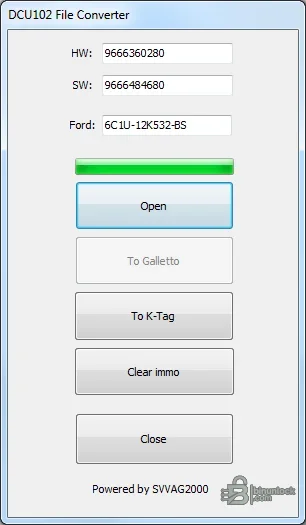
The utility does not communicate with the ECU and cannot determine whether a programmer made a full, partial or padded read. Conversion is safe only when the input belongs to the expected DCU10x family and the output format matches the exact tool and protocol used for the next write.
What this resource is for#
Use the converter when the same supported Visteon ECU data must be moved between two programmer-specific layouts or when an authorized repair calls for the provided immobilizer-data operation. The original read remains the recovery master and should never be overwritten.Functions included#
- Open a supported Visteon DCU10x dump
- Display detected hardware and software identifiers
- Display the Ford calibration or part identifier found in the file
- Convert a recognized FGTech/Galletto layout to KTAG format
- Convert a recognized KTAG layout to FGTech/Galletto format
- Apply the supported immobilizer-clear operation to a working copy
Supported vehicles, controllers and file types#
- Visteon DCU10x-family files recognized by the application
- The source folder and interface specifically identify DCU102 while the product scope is described as DCU10x
- Ford identifiers are displayed when present in the supported file
- Exact byte length and programmer read mode must match the conversion direction
- No support is claimed for unrelated Visteon DCU, SID or EMS families
Package contents#
- Single self-contained Windows converter
- Original interface screenshot
- No ECU programmer, driver, pinout, stock file or recovery firmware
- No generic dump collection
System, hardware and interface requirements#
- Windows PC or isolated VM
- Known-good ECU dump from KTAG or FGTech/Galletto
- Exact ECU label and programmer protocol information
- Binary comparison and checksum verification
- Stable bench setup and recovery-capable programming method
Recommended workshop workflow#
- Identify the exact vehicle, ECU label, hardware number, software number and reading method before opening a file.
- Read the controller twice where practical, compare the two reads and keep one untouched original outside the working folder.
- Work on a copy with the same byte length and segment type expected by the selected function.
- Save the result under a new name and compare every changed region against the original before considering a write.
- Verify checksum handling with the programmer or an appropriate independent tool for the exact controller family.
- Use regulated power and a documented bench, boot or recovery route if the modified file is written to a module.
- After installation, complete identification, fault-code and functional checks before returning the vehicle to service.
Compatibility limits and responsible use#
- A file opening successfully does not prove that its software revision or internal layout is supported.
- A full read, calibration-only read, virtual read and reconstructed file are not interchangeable unless the workflow explicitly says so.
- The application does not identify unknown hardware, choose the correct programmer protocol or provide a recovery backup.
- Do not write output with unexplained size changes, unusually broad modifications or a failed checksum check.
- Immobilizer, identity, emissions and safety-related work must be authorized and lawful for the vehicle being serviced.
- Do not convert the same output repeatedly between formats; always restart from the original read.
Troubleshooting#
- File is rejected: verify controller family, software number, byte length and whether the tool expects EEPROM, flash or calibration data.
- No change is produced: the selected signature or table may not exist in that software revision; do not force a similar profile.
- Output differs in many unrelated areas: stop, restore the original working copy and confirm the input format.
- Program will not start: keep every supplied runtime and activation component together and try an isolated compatible Windows environment.
- Module does not communicate after writing: use the prepared recovery method and restore the exact original rather than making more edits.


