
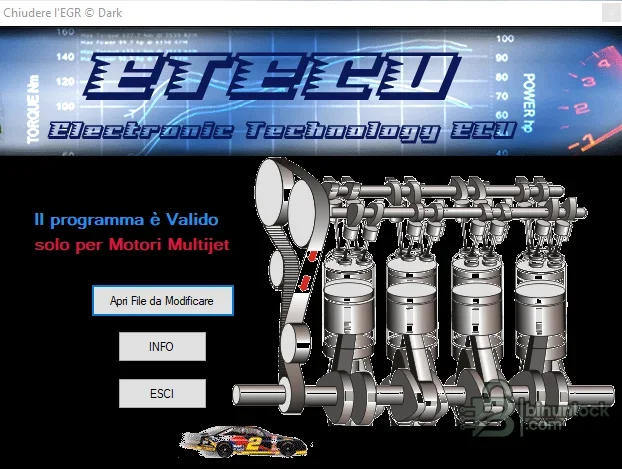
Fiat Multijet EGR Deactivator is a compact offline utility for processing supported Fiat Group diesel ECU binaries when an authorized calibration workflow requires an EGR-related file change. The application opens an existing ECU file and creates a modified result; it does not connect to the vehicle, diagnose the cause of an EGR fault or read and write the controller.
Compatibility must be established from the exact ECU label, Bosch or Marelli controller family, engine code, hardware/software numbers, source-file type and file length. A generic Multijet label is not enough for a safe write.
The utility does not remove hardware, repair a stuck valve, diagnose wiring or airflow faults, reset learned values or guarantee checksum correction for every controller. Those tasks require separate mechanical, diagnostic and programming work.
Before editing, diagnose the underlying complaint. EGR faults may come from the valve, cooler, position sensor, vacuum control, wiring, intake deposits, airflow meter or boost leaks. A file change is not a substitute for repairing a safety or mechanical fault.
The application cannot determine whether the source file is original, tuned, corrupted or from another vehicle. Do not process a file of unknown origin or write a result to a controller with a different hardware or software identity.
For support, include engine code, ECU manufacturer and part numbers, read tool and mode, original/result sizes and redacted DTCs. Do not upload a full customer binary or VIN publicly.
Confirmed scope#
The supplied interface explicitly states that the program is valid only for Multijet engines. That supports a Fiat Group Multijet scope, but the package does not provide a trustworthy model, engine-code, ECU-part-number or software-number list. It should not be treated as a universal solution for all Fiat, Alfa Romeo, Lancia, Jeep, Opel or other vehicles that may use related diesel engines.Compatibility must be established from the exact ECU label, Bosch or Marelli controller family, engine code, hardware/software numbers, source-file type and file length. A generic Multijet label is not enough for a safe write.
What the utility does#
- Opens a previously read ECU binary
- Processes the supported EGR-related calibration area
- Saves a separate file for review and later programming
- Keeps the operation offline so original and result can be compared
The utility does not remove hardware, repair a stuck valve, diagnose wiring or airflow faults, reset learned values or guarantee checksum correction for every controller. Those tasks require separate mechanical, diagnostic and programming work.
Required tools and preparation#
- Windows computer for the portable file application
- OBD, bench, boot or BDM programmer proven for the exact ECU
- Stable regulated power for reading and writing
- A full diagnostic scan including air-mass, boost, EGR command and position data
- Two matching original reads and a protected recovery copy
- Checksum and binary-comparison tools appropriate to the ECU family
Before editing, diagnose the underlying complaint. EGR faults may come from the valve, cooler, position sensor, vacuum control, wiring, intake deposits, airflow meter or boost leaks. A file change is not a substitute for repairing a safety or mechanical fault.
Recommended workflow#
- Record vehicle, engine and ECU identification plus all relevant diagnostic faults.
- Confirm the intended use is lawful and technically justified.
- Read the ECU twice in the correct mode and compare hashes.
- Protect the original and open only a working copy.
- Run the file operation and save the result separately.
- Verify output length, changed ranges and checksum handling.
- Program with stable voltage and read back or verify where the tool supports it.
- Clear faults only after repair, then validate live data, boost control and drivability.
Compatibility and legal limitations#
EGR strategy is part of the certified emissions calibration. Disabling emissions equipment may be prohibited for public-road use and can create inspection, registration or environmental consequences. Use the software only where the work is legally permitted, such as an authorized off-road, competition, development or controlled repair context.The application cannot determine whether the source file is original, tuned, corrupted or from another vehicle. Do not process a file of unknown origin or write a result to a controller with a different hardware or software identity.
Troubleshooting#
If the file is rejected, verify that the engine is genuinely Multijet, identify the ECU family and confirm whether the read is full flash or calibration-only. If the output is unchanged or the vehicle develops a no-start or checksum fault, restore the original immediately and review the read/write method. Persistent EGR-related faults after a file operation require proper diagnosis of sensors, wiring and mechanical components.For support, include engine code, ECU manufacturer and part numbers, read tool and mode, original/result sizes and redacted DTCs. Do not upload a full customer binary or VIN publicly.


