
VAG ECU ID by Vitdia is a group of offline firmware-identification utilities that extract human-readable controller and vehicle information from supported binary files. The main interface can display ECU family, software number, engine displacement, engine code, manufacturer, model and feature flags recovered from a recognized calibration.
Five related applications are included, covering different parser generations and selected non-VAG layouts. They analyze files only; they do not connect to a vehicle or change a controller unless a separate modification workflow is deliberately used.
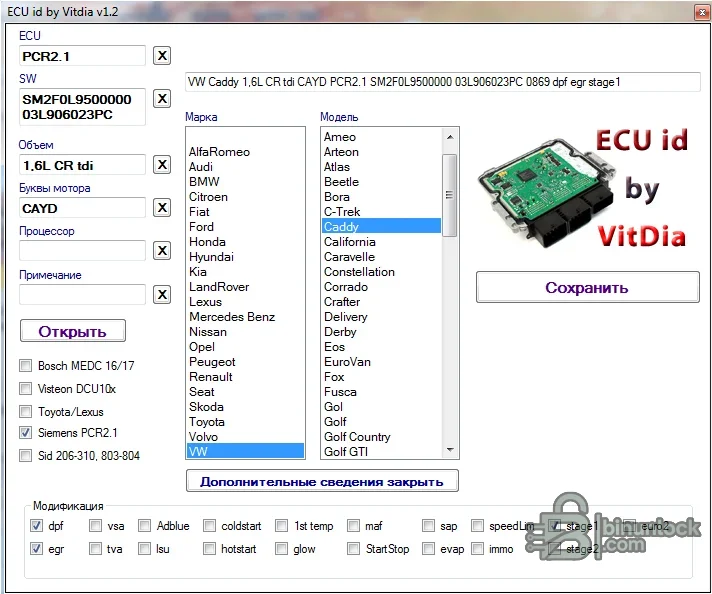
Five related applications are included, covering different parser generations and selected non-VAG layouts. They analyze files only; they do not connect to a vehicle or change a controller unless a separate modification workflow is deliberately used.
What this resource is for#
Use the suite to label unknown reads, confirm that a file belongs to the expected ECU and collect identifiers before opening a tuning or repair project. Identification is especially useful when filenames have been lost or several reads from similar vehicles are stored together.Confirmed functions#
- Extract ECU family, software identifiers and engine information from recognized firmware
- Show manufacturer and model candidates associated with detected data
- Display modification flags such as DPF, EGR, AdBlue, start-stop, speed limiter and immobilizer markers when the parser finds them
- Save or document parsed identity information
- Separate parsers for general ECU ID, VAG MEDC17, Opel ECU ID and earlier VAG formats
Supported controllers, files and vehicles#
- Bosch MEDC16 and MEDC17 families where supported by the parsers
- Siemens PCR2.1
- Visteon DCU10x
- Selected SID206, SID310, SID803 and SID804 layouts
- A Toyota/Lexus parser and an Opel-specific identifier are also supplied
- The visible manufacturer list includes many brands, but actual results depend on firmware signatures
Package contents#
- Current ECU ID application
- Earlier general ECU ID branch
- VAG ECU ID and VAG MEDC17-specific utilities
- Opel ECU ID utility
- Five portable executables, all statically audited and never launched
System and interface requirements#
- Windows PC or isolated virtual machine
- A complete binary read from the ECU memory region expected by the parser
- Known-good source hash and a clear record of the read method
- No diagnostic interface is needed for offline identification
Recommended workshop workflow#
- Copy the original read into a read-only identification workspace
- Open it with the parser that best matches the suspected controller family
- Compare reported software and engine identifiers with the ECU label or diagnostic scan
- Save the identification result and use it to choose the correct editor, checksum and programming method
- Keep unknown or contradictory reads quarantined until independently identified
Compatibility limits and responsible use#
- Model lists shown by the application are candidates, not guaranteed compatibility statements
- An identification hit does not prove that a tuning definition or checksum plugin matches
- Feature flags are parser observations and should be confirmed by inspecting the binary
- Do not rename or overwrite the original read until identification is independently verified
Troubleshooting#
- If fields remain blank, try the parser dedicated to the suspected controller family
- If the software number conflicts with the ECU label, verify that the file is complete and not a calibration-only segment
- If several model candidates appear, rely on engine code, hardware number and diagnostic data to narrow the identity


